

Description
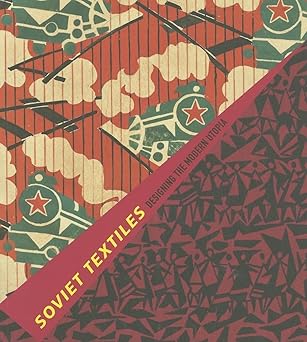
Between 1927 and 1933, as the new Soviet Union emerged and the Communist party struggled to transform an agrarian country into an industrialized state, a group of young artists pitched in by designing fabrics depicting tractors, smokestacks and symbols of collective modernity, cloth with which to mold its buyers into ideal Soviet citizens. Few of these designs ever saw mass production, and the experiment failed as propaganda–comrades clung to their traditional floral motifs–but it yielded bold and intriguing new designs.
![Alter Icons: The Russian Icon and Modernity (Studies of the Harriman Institute, Columbia University) [Hardcover] Gatrall, Jefferson J. A. and Greenfield, Douglas](https://artwheelshop.com/wp-content/uploads/2025/10/91CgpsuEWaL._SY342_-1.jpg)
![Los Princeles De La Historia La Fabrication Del Estado 1864 -1910 [Hardcover] Esther Acevedo; Fausto Ramirez and Jaime Cuadriello](https://artwheelshop.com/wp-content/uploads/2025/10/21lBH0loFKL-1.jpg)
![Georgia's Legacy: History Charted Through the Arts [Paperback] Doezema, Marianne; Smith, Jane Webb; Schneiderman, Richard S. and Spalding, Phinizy](https://artwheelshop.com/wp-content/uploads/2025/10/81WAIZNWVoL._SY466_-1-300x450.jpg)

![Byzantine Things in the World [Hardcover] Peers, Glenn; Barber, Charles; Caffey, Stephen; Franses, Henri Rico and Shiff, Richard](https://artwheelshop.com/wp-content/uploads/2025/10/41Z0cRailNL._SY425_-1-300x425.jpg)


![The Horse in Ancient Greek Art [Hardcover] Stribling, Nicole; Schertz, Peter; Hemingway, Seán; Mattusch, Carol C.; Oakley, John and Pevnick, Seth](https://artwheelshop.com/wp-content/uploads/2025/10/81966PCS1hL._SY425_-1-300x425.jpg)
![Porcelain: A History from the Heart of Europe [Paperback] Marchand, Suzanne L.](https://artwheelshop.com/wp-content/uploads/2025/10/711RJEXsO4L._SY385_-1.jpg)
