
Description
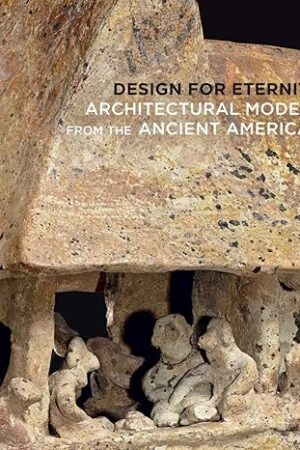
From the first millennium B.C. until the arrival of Europeans in the 16th century, artists from across the ancient Americas created small-scale architectural effigies to be placed in the tombs of important individuals. These works in stone, ceramic, wood, and metal range from highly abstracted, minimalist representations of temples and houses to elaborate complexes populated with figures, conveying a rich sense of ancient ritual and daily life. Although described as models, these effigies were created not so much as reflections or prototypes of existing structures, but rather as critical, conceptual components of funerary practice and beliefs about an afterlife.
![The Jewelry and Metalwork of Marie Zimmermann [Hardcover] Deborah Dependahl Waters; Kimberley Ahara; Bruce Barnes and Joseph Cunningham](https://artwheelshop.com/wp-content/uploads/2025/10/51-271x8apL._SY425_-1-300x425.jpg)
![Nam June Paik: Becoming Robot [Hardcover] Asia Society; Chiu, Melissa and Yun, Michelle](https://artwheelshop.com/wp-content/uploads/2025/10/61YM9OYqnL._SY466_-1-300x450.jpg)
![Frans Wildenhain 1950-75: Creative and Commercial American Ceramics at Mid-Century [Hardcover] Austin, Bruce A. and Profusely illustrated](https://artwheelshop.com/wp-content/uploads/2025/10/71ZQm1MYQNL._SY425_-1-300x425.jpg)



![Make It New: Abstract Painting from the National Gallery of Art, 19501975 [Paperback] Cooper, Harry; Breslin, David and Jolly, Matt](https://artwheelshop.com/wp-content/uploads/2025/10/61i1k-PWaAL._SY522_-1-300x450.jpg)
![Ancient Bronzes through a Modern Lens: Introductory Essays on the Study of Ancient Mediterranean and Near Eastern Bronzes [Paperback] Ebbinghaus, Susanne; Anderson, Lisa; Bewer, Francesca G.; Bielfeldt, Ruth; Eremin, Katherine; Hemingway, Seán; Lie, Henry; Mattusch, Carol C.; Riederer, Josef and Staehli, Adrian](https://artwheelshop.com/wp-content/uploads/2025/10/516k-q2VTKL._SY385_-1.jpg)
![Casting a Shadow: Creating the Alfred Hitchcock Film [Paperback] Schmenner, Will and Granof, Corinne](https://artwheelshop.com/wp-content/uploads/2025/10/81D2s-ypoAL._SY466_-1-300x450.jpg)